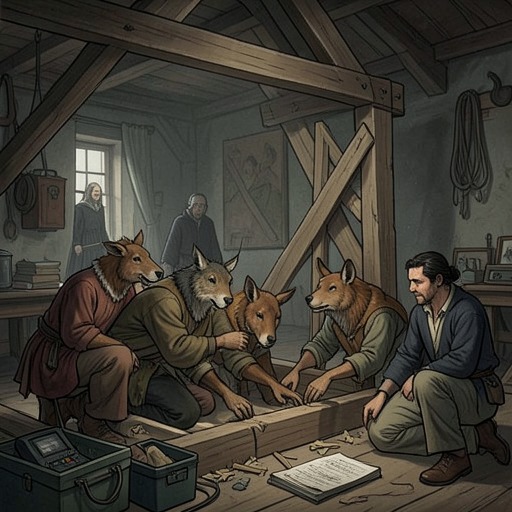
“All find what they truly seek”
The Last Battle“All find what they truly seek” names the principle by which Aslan welcomes Emeth, a lifelong worshipper of Tash, into his presence: Emeth’s honest desire for what is good has been directed, in his understanding, toward the wrong god, but that desire has nevertheless led him to Aslan. The expression does not erase the difference between the gods. Aslan explicitly rejects the Ape’s claim that Tash and Aslan are one, distinguishing instead between the goodness and cruelty embodied by their respective names.
The Expression in Emeth’s Encounter
Emeth recounts that, after entering the Stable, he wandered through grass, flowers, and trees until he met a great Lion between two rocks. Expecting death because he had served Tash rather than Aslan, he judged it better to see the Lion and die than to live without that encounter. Instead, Aslan welcomed him, touched his forehead with his tongue, and called him a son. Emeth protested that he was Tash’s servant; Aslan answered that the service Emeth had done to Tash counted as service done to Aslan.
The explanation turns on the character of the service, not merely the name under which it was offered. Aslan says that an oath kept for the sake of keeping it is truly sworn by him, even if the person swearing does not know this; conversely, cruelty committed in Aslan’s name serves Tash. The expression follows that distinction: Emeth’s long search for wisdom and understanding reveals a desire that the mistaken label of his allegiance could not define. Aslan tells him that, had his desire not been for Aslan, he would not have sought so long and so truly.
Reversal of the Ape’s Claim
Earlier, the Ape had insisted that Tash was merely another name for Aslan and that the two peoples meant the same thing by different words. The Lamb’s objection—that the Calormenes worshipped a god associated with killing people on an altar, while the Narnians belonged to Aslan—had been recognized by the animals as the strongest question raised against the Ape. The Ape answered it by spitting at the Lamb and declaring the gods identical. Aslan’s later account decisively reverses that coercive simplification: he says the claim is false precisely because he and Tash are opposites.
The expression therefore cannot be read as saying that every religious claim is interchangeable or that deeds lose their moral weight. Aslan’s account makes the opposite point: a person’s actions disclose the allegiance that words may conceal or misunderstand. Emeth’s genuine devotion to truth is accepted, while a cruel act does not become good merely because its perpetrator uses Aslan’s name. The maxim concerns the direction of a person’s true desire and the moral substance of service, rather than a blanket approval of every belief or action.
From Apparent Absence to Recognition
Before the final revelation, Narnian creatures have been taught to interpret violence and enslavement as Aslan’s orders. The animals wonder whether they have done something wrong and are being punished; some say they had wanted Aslan to return, only to believe that he has returned in anger. When Tirian calls repeatedly for Aslan and asks him to save Narnia, the darkness and cold do not change. Yet Tirian begins to feel a faint hope and strength within himself, and asks that help from beyond the world be sent if Aslan will not come in person.
At the Stable, Aslan does appear. He praises Tirian as the last King of Narnia who stood firm at the darkest hour, then demonstrates that the Dwarfs will not accept help: they interpret even his growl as a trick. Aslan says their prison is in their own minds, and turns from them to open the Door. The contrast with Emeth is pointed: the Dwarfs resist the possibility of truth because they fear being deceived, whereas Emeth, though afraid, meets Aslan with a sincere desire to understand. The maxim’s promise is not a claim that every creature recognizes the truth in the same way; the narrative also shows creatures turning away from Aslan and disappearing into his shadow.
Judgment, Mourning, and the Real Narnia
As the creatures approach Aslan, their response becomes decisive. Those who look at him with fear and hatred turn away; Talking Beasts among them cease to be talking animals. Others look at him with love, even when frightened, and enter through the Door. Among those welcomed are creatures thought dead, including Roonwit, Jewel, Farsight, the Dogs, the Horses, and Poggin. The scene gives the expression a wider setting: finding what one truly seeks is bound up with recognition and judgment, not simply with passing through a doorway.
The old Narnia nevertheless ends. At Aslan’s command, the Time-giant extinguishes the Sun, and the gathered company sees the world’s destruction. Lucy mourns what lies dead and frozen behind the Door; Tirian says that the women do well to weep and that it would be discourteous not to mourn a world that has been his home. Digory explains that the Narnia they knew had a beginning and an end, while the real Narnia has always existed and will always exist; the old world was its shadow or copy, and the dear creatures who mattered have been drawn into the real Narnia. Thus the expression offers hope without making grief unreal: finding a lasting home does not mean that the ending of the familiar world is painless.
The Story’s Final Horizon
Aslan later tells the children that a real railway accident has occurred and that they, along with their parents, are dead in the Shadow-Lands. He describes the end of their former life as the beginning of the morning, and the narrator presents their adventures as the cover and title page of the Great Story, whose chapters continue forever and grow better. In that final frame, the expression reaches beyond Emeth’s particular welcome. The story closes by joining sincere seeking to a larger reality in which the ending of one world is not the end of all life, while keeping moral distinctions intact: what matters is not only the name a seeker has used, but the truth and goodness the seeker has genuinely pursued.